


Students as Partners in Developing the University’s Spatial Digital Estate
How authentic work experience with Digital Estates is helping Geography students develop professional skills while contributing to the University’s digital transformation.
How authentic work experience with Digital Estates is helping Geography students develop professional skills while contributing to the University’s digital transformation.
Every university faces the challenge of preparing students for an increasingly complex workplace while responding to its own strategic priorities. At the University of Exeter, a partnership between the Geography Department and the Digital Estate Team demonstrates how these ambitions can reinforce one another. As the University continues to develop its spatial digital estate, students are contributing to real projects that support institutional priorities while gaining authentic professional experience.
At the heart of this collaboration is the use of Geographic Information Systems (GIS) and ArcGIS, the platform for managing and visualising spatial data. Estate Services is
developing ArcGIS as a trusted, central source of spatial information, supporting
everything from campus planning and asset management to accessibility, sustainability
and operational decision-making. For our students, this creates something far more
valuable than a classroom exercise: the opportunity to work on projects that have
genuine purpose and lasting impact, e.g. Figure 1.
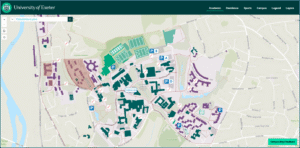
Figure 1. Exeter Campus Map. Example project where The Digital Estate Team were tasked to create a spatially accurate, interactive web map covering all four campuses using Esri software.
Authentic work experience
Through placements, internships and MSc dissertation consultancy projects, our students work alongside colleagues in the Digital Estate Team on live projects. They engage with real stakeholders, work with enterprise datasets and develop solutions that continue to be used after their projects have finished.
Recent projects have included interactive campus mapping, digital asset management, mobile field surveys, accessibility mapping, infrastructure inspections and supporting the development of a spatially enabled digital estate. Students are not just completing tasks to gain experience and complete their degree; they are helping solve real institutional challenges.
An examples of placements as part of the Sustainability in Practice (Work Placement) module, includes 2 students creating a roof access survey web app. Jacob Weinbren and Sean Berry were on a month-long placement which led to the development of a visualisation and centralised system of roof access data across the University of Exeter’s campuses. The web app now actively supports both external surveyors and university staff who require access to roof access data.
As well as placements, we have examples of students working with the digital estates team as part of their dissertation applied consultancy project. Christie Dodsworth a current GIS MSc student is working with Amber McDonagh, conducting a pilot study to demonstrate the value of drone-derived data and digital twins for estate management (Figure 2).

Figure 2. Drone view of part of the sports part captured by Christie Dowdsworth as part of her dissertation project data collection.
Student Christopher Townsend is mapping surface water run-off from campus as part of the Nature Positive Strategy with support from Rosalind Shaw (Sustainability manager), Figure 3.

Figure 3. Reed Hall pond. Just one of the elements feeding into Chris’ analysis of water storage and run-off on campus.
The success of the curriculum embedded approach enabling partnerships with Geography and Placements in the Digital Estates Team has led to new opportunities to students through paid placements. Rosalind Shaw, University of Exeter sustainability manager identified funds to employ GIS MSc student Ryan Reeve to turn Dr Crowley and Abhishek Dixit data into a Penryn multispecies campus map showcasing our diverse wildlife on campus (Morrison, 2026 ‘Multispecies Map’ reveals diverse wildlife on university campus – University of Exeter News). The multispecies map shown below is available here https://exeter.ac.uk/multispeciesmap
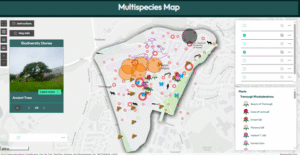
Figure 4. Penryn Multispecies Map.
Developing professional skills
Working in a professional environment enables students to develop much more than technical GIS expertise. Students learn how to interpret client requirements, communicate with non-specialists, manage projects, present evidence, and work within governance and data quality standards. These are precisely the transferable skills that employers consistently identify as essential.
Perhaps most importantly, students begin to see themselves as professionals. They gain confidence by contributing to meaningful work and understanding how geospatial technologies create value within a complex organisation (Figure 5).
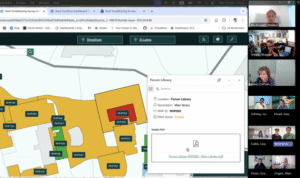
Figure 5. Students showcasing the product from their placement to the estates team.
The partnership has also come full circle. The University’s Lead GIS Analyst, Amber McDonagh is a graduate of Exeter’s MSc Geographical Information Science programme, demonstrating how graduate talent can develop into institutional expertise. Having recently made the transition from student to professional, she brings a unique understanding of both the academic programme and the operational needs of the University. This shared perspective has helped strengthen the partnership between Geography and the Digital Estate Team, creating opportunities that are both educationally meaningful and operationally valuable.
Professional Services as educational partners
This collaboration highlights the important educational role that Professional Services colleagues can play. Academics provide the pedagogical framework, the digital estates team provide the projects, operational expertise and requirements. We work with Professional Services colleagues as partners in education. Together, we create learning experiences that are academically rigorous, professionally relevant and beneficial to the wider University.
Looking ahead
As universities seek new ways to enhance graduate employability and strengthen collaboration across the institution, partnerships like this offer a powerful model for authentic learning.
By aligning teaching with real organisational challenges, students become meaningful contributors while developing the knowledge, skills and confidence that come from authentic professional experience. They leave university not only with technical expertise, but with the confidence, professional identity and practical experience that come from making a meaningful contribution.
Thanks to Amber McDonagh and the whole Digital Estates Team for these and ongoing authentic work experience collaborations.
For more information
This post was written by Dr Damien Mansell