
When the campus is gone: keeping postgraduate supervision visible under disruption in Gaza
What does postgraduate supervision need to look like when the usual structures of higher education have been severely disrupted?
What does postgraduate supervision need to look like when the usual structures of higher education have been severely disrupted? In this post, Dr Kinan Mokbel and Dr Ahmed Nijim reflect on a practical supervision prompt developed through collaboration between Exeter and colleagues in Gaza. The prompt was designed to help supervisors and students keep progress, ethics, documentation and humane expectations visible when communication, access and continuity could not be taken for granted.
Why this was not just a remote-learning problem
Remote supervision is often discussed as a question of platforms, engagement and good online practice. In Gaza, the issue is far more serious. Higher education has been profoundly disrupted by the destruction of campuses, laboratories, libraries, ICT infrastructure and the loss of staff and students. UNESCO’s recent assessment of higher education institutions in Gaza reported extensive damage across campuses and described higher education as crucial to recovery, opportunity and future rebuilding.
That context matters for educators. When the physical university is damaged or inaccessible, supervision cannot rely on the ordinary rhythms of academic life. Students may not have stable internet. Supervisors may be displaced, overloaded or unreachable. Files can be lost. Meetings can be interrupted. Ethical decisions and data-handling questions can become harder to track. In that situation, supervision needs more than goodwill. It needs a structure that is light enough to use, but clear enough to protect progress.
Over the past couple of years, we have been working together through Exeter-Gaza academic collaboration to support postgraduate students, supervisors and manuscript-development work. The aim was not to import a perfect model from one university to another. It was to develop a practical way of keeping supervision conversations clear, realistic and humane under conditions of disruption.
From Exeter supervision practice to Gaza adaptation
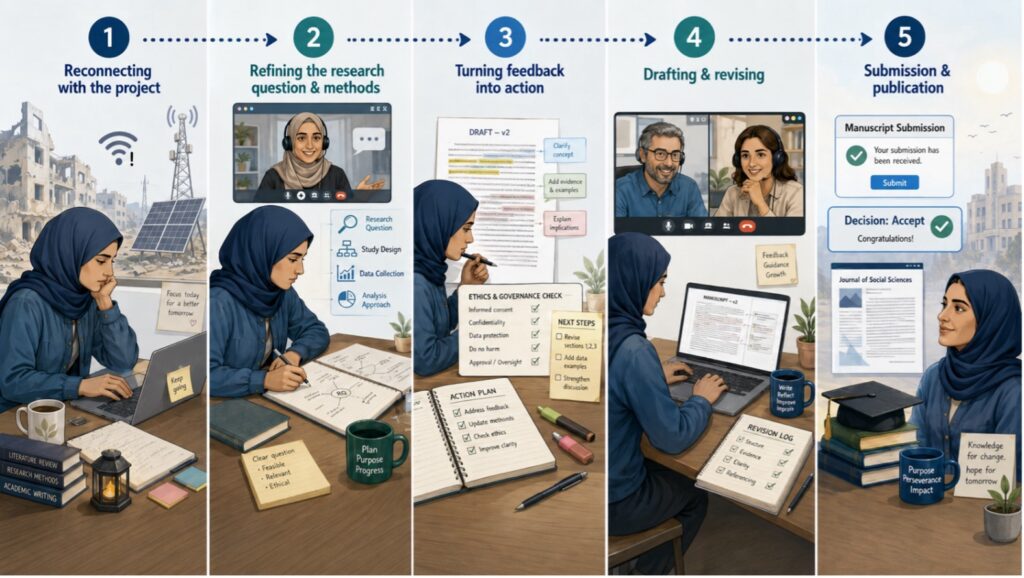
This work built on supervision-development practice Kinan had been using in Exeter. In postgraduate supervision and research mentoring, he found that students and newer supervisors often benefit when expectations, milestones, feedback routes and governance decisions are made explicit rather than assumed. In Exeter, this meant using staged checkpoints, written follow-up and earlier ethics or data-governance conversations to reduce uncertainty. Working with Ahmed and colleagues in Gaza, we adapted the same principle for a much more disrupted context: a short, practical prompt that could help supervisors and students keep progress, responsibilities, file versions and fallback plans visible when ordinary supervision routines could not be relied on.
What we tried: a short supervision prompt
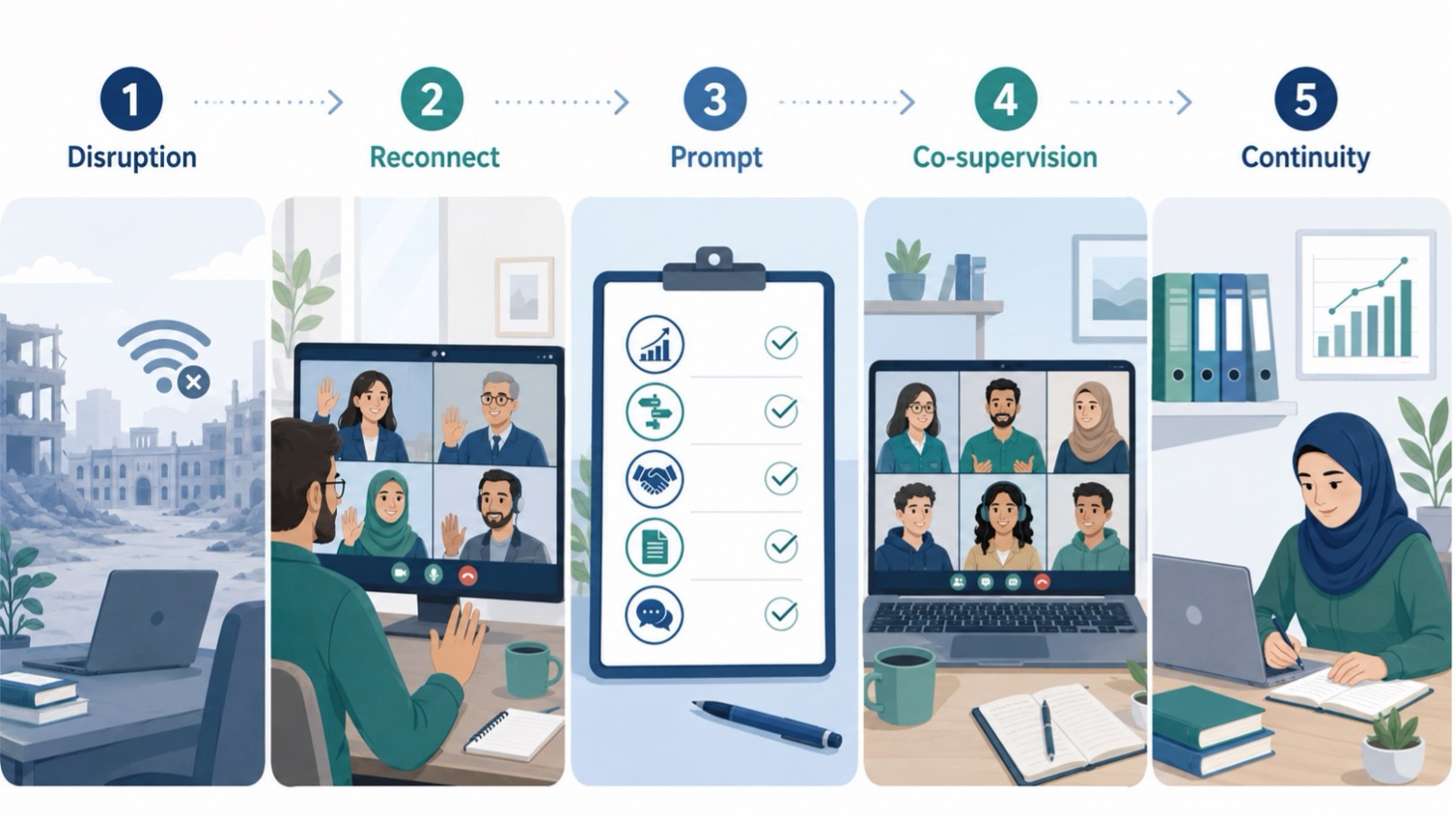
We developed a short remote supervision prompt that could be used in a live meeting, an email check-in or an asynchronous exchange. It focused on five areas.
First, progress and blockers: what has been completed since the last check-in, and what is the biggest obstacle now?
Second, next steps: what will be done next, by when, and what is needed from the supervisor or co-supervisor?
Third, quality, ethics and governance: is there anything that needs an ethics check, data-handling clarification or explicit note in the write-up?
Fourth, documentation: where is the current version saved, what is the file name and date, and what decisions need recording?
Finally, disruption planning: what communication route is most reliable at the moment, and what fallback plan should be used if contact is suddenly interrupted?
These are simple questions, but simplicity was deliberate. Under pressure, a supervision tool has to survive real working conditions. If it is too long, it will not be used. If it is too vague, it will not help.
What changed in practice
Ahmed used the template in supervision and manuscript meetings, and shared it with colleagues involved in co-supervision. Several colleagues then began using or adapting it, particularly the sections on agreed next steps, ethics and quality checks, documentation, file versions and fallback planning.
The main change was not administrative. It changed the structure of the conversation. Meetings became less dependent on memory or informal follow-up. Students and supervisors had a clearer record of progress, blockers, responsibilities and deadlines. Co-supervisors had less ambiguity about what had been agreed.
The ethics and governance section was especially important. In disrupted contexts, there is a risk that ethics, consent and data-handling questions become delayed until the end, when they are harder to repair. Bringing those questions into each supervision check-in made the work more defensible while still keeping the tone supportive.
What other educators can take from this
This example comes from Gaza, but the learning is wider. Supervision can become fragile in many settings: international collaborations, part-time study, placement-based research, staff absence, caring responsibilities, unstable internet or cross-institutional co-supervision.
The lesson for educators is that flexibility needs structure. Without structure, students may feel supported but still remain unclear about what to do next. Without flexibility, standards can become unrealistic or even exclusionary. The task is to hold both together.
A short supervision prompt cannot repair the destruction of higher education in Gaza. But it can help protect academic continuity in one small, practical way. It keeps decisions visible. It makes ethics part of the conversation. It reduces reliance on memory. It gives students and supervisors a shared thread to return to when everything else is uncertain.
For us, that is the central lesson: in disrupted higher education, humane supervision is not less rigorous. It is clearer, more explicit and more carefully documented.
Suggested further reading
1. UNESCO. In Gaza, UNESCO supports students amid a devastated education landscape. Available from: https://www.unesco.org/en/articles/gaza-unesco-supports-students-amid-devastated-education-landscape
2. UNESCO. Assessment of damage and reconstruction needs for higher education institutions in Gaza. Available from: https://www.unesco.org/en/articles/unesco-presents-assessment-damage-and-reconstruction-needs-higher-education-institutions-gaza
3. OHCHR / UN experts. UN experts deeply concerned over “scholasticide” in Gaza. Available from: https://www.ohchr.org/en/press-releases/2024/04/un-experts-deeply-concerned-over-scholasticide-gaza
4. INEE. Minimum Standards for Education: Preparedness, Response, Recovery. Available from: https://inee.org/minimum-standards
5. Henshaw LA. Building Trauma-Informed Approaches in Higher Education. Behavioral Sciences. 2022; 12(10):368. https://doi.org/10.3390/bs12100368
For more information
Dr Kinan Mokbel (Senior Lecturer at University of Exeter, Honorary Professor at Brunel University London) and Dr Ahmed Nijim (Research Fellow at University of Exeter, Assistant Professor at Al-Azhar University, Gaza).