

Medicinal Roots: Uncovering Histories, Rebuilding Futures
Decolonising medicine starts in the classroom After completing the 'Decolonising Medicine' module, four fellow Medical Sciences students and I wanted to explore this topic further.
Decolonising medicine starts in the classroom
After completing the ‘Decolonising Medicine’ module, four fellow Medical Sciences students and I wanted to explore this topic further. Our lecturers encouraged us to apply to Grand Challenges, and this is where we developed our idea and turned it into a successful Grand Challenges project.
Decolonisation is about healing narratives and relationships that were broken through colonisation. Within healthcare, decolonisation challenges the widespread belief that Western medicine and healthcare models are superior. This is a harmful narrative, as Western medicine is based on knowledge taken from traditional Indigenous knowledge systems, and contributions from the Global South that often went uncredited, were appropriated, or were initially ignored. For instance, why, when the history of vaccination is taught in school, Jenner is discussed, but the Indian and Chinese practices of inoculation for hundreds of years prior to Jenner’s work are not included? Or, why is Mary Seacole referred to as ‘the black Florence Nightingale’? These narratives are harmful, and the fact that these people and their contributions to medicine and healthcare are still not recognised in education before university or consistently taught across medical schools.
This contributes to patients being overlooked, medically gaslit, or misdiagnosed within healthcare. Decolonisation and equitable training were not a formal requirement until 2020, and there is still variation in the implementation between institutions. A 2016 study (Hoffman et al.) reported disparities in the prescription of pain medication between Black and White patients. The study also reported that doctors with racial biases were less accurate in their diagnosis, and that a high percentage of White medical students believed common misconceptions, including Black people having thicker skin and stronger bones. This is an example of how a lack of culturally representative and inclusive education leads to poor practice within healthcare systems.
We participated in the Social Justice challenge focused on social justice in healthcare, and three other students joined us from a range of disciplines to create our Grand Challenge group. Our idea was to introduce age-appropriate conversations around decolonisation at different levels of education, as many of us had not heard this word before starting university. We created an activity book (images attached) for primary school-aged children, a card game and revision materials (images attached) for secondary students, and self-teaching and debate materials for sixth-form/college students.
When we started working on this project, we didn’t realise we would be revisiting this nine months later, but the potential of this idea was hard to overlook. Two of us have pursued this project in the Student Start-ups programme and refined the idea into a more feasible social enterprise. We are now building connections with schools and planning to pilot our resources and workshops in local primary schools.
Grand Challenges was an amazing opportunity to develop our ideas and spend a week collaborating with other students passionate about addressing today’s challenges and social issues. This was also an incredible opportunity to see other people’s approaches and solutions to the current issues.
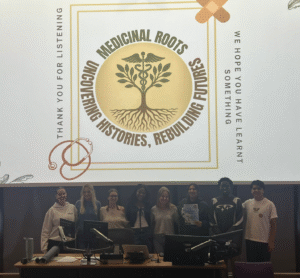
Photo taken at Grand Challenges Showcase
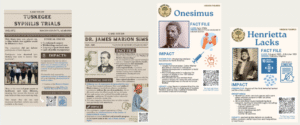
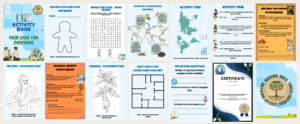
Workbook pages and info sheets created at Canva.com.
For more information
This post was written by Zaynab Ali and Grace Thomas