


Methods for teaching methods: reflections on sparking ‘aha’ moments
While the teaching of research methods is core to social science and cognate disciplines, pedagogic attention to research methods education has been conspicuously lacking.
While the teaching of research methods is core to social science and cognate disciplines, pedagogic attention to research methods education has been conspicuously lacking. In this post, I reflect on the publication of a recent National Centre for Research Methods resource (including my contribution to it) designed to buck that trend and to support educators in generating ‘aha’ moments in their research methods teaching.
With an increasing emphasis in higher education (HE) on skills-embedding (Toogood 2025), research methods training has taken on particular significance in recent years. Research methods education is, however, a pedagogic area beset by challenges. For starters, unlike more substantive disciplines, it is not an established field, with a dearth of dedicated scholarly journals. Moreover, as Mark Earley (2014: 243) notes in his synthesis of the literature on research methods education, “even though research methods courses are a staple in many undergraduate and graduate programs, teachers…rarely receive formal instruction in how to teach research methods.” As a result, research methods courses are often developed through ‘trial-and-error’ approaches (Earley 2014: 243). Indeed, this pattern perpetuates partly because research methods education is often not deemed a specialism – while teaching substantive content requires specialist knowledge, teaching research methods is something everyone in a department is expected to be able to do, because every academic does research, right?
Such attitudes to research methods education – as an adjunct to expert-led teaching on substantive modules – is perhaps not advisable if National Student Survey (NSS), Postgraduate Taught Experience Survey (PTES) and other measures of teaching quality are to be valued. As Earley’s (2014: 245-6) synthesis shows, across a range of studies, students taking research methods courses have a range of negative dispositions to those courses – from failing to see the relevance of the courses to feeling unmotivated to learn the material. This is compounded by evidence of systematic negative biases in student evaluations of teaching towards compulsory courses on degree programmes (which methods courses typically are) and towards quantitative skills courses in particular (Centra 2009 3-4).
An emerging pedagogical culture in research methods education
Thankfully, work is underway in HE to improve research methods pedagogy. Not in the least, in the social sciences the National Centre for Research Methods (NCRM) has spearheaded this work in the UK. Through the work of Professor Mel Nind (Southampton) and others in the NCRM Pedagogy Network, NCRM have compiled an invaluable set of resources for trainers, from video tutorials to bitesize lessons. The intention here is to disrupt the ‘trial-and-error’ paradigm and provide trainers with a suite of resources they can draw on as they develop, deliver and update their research methods training.

Photo by Vitaly Gariev on Unsplash
In the course of my academic career, NCRM’s support has been invaluable, through the free-to-download resources they produce (the review paper How many qualitative interviews is enough being a particular favourite) and the funding they’ve provided for my own research (which you can learn more about via my ‘Policy Pod’ podcast for the University of Auckland). I was therefore delighted to have the opportunity to contribute to one of their latest resources, namely Sparking ‘Aha’ Moments: A Resource for Teaching Research Methods.
Sparking ‘aha’ moments for research methods students
To compile this resource, members of the NCRM Pedagogy Network were asked to engage with one key question: how do we spark ‘aha’ moments in the research methods learning we deliver? The idea was to create a curated set of responses to this question that other methods teachers might take inspiration from. With that in mind, the outcome was a set of reflections and ideas “loosely ordered as: supporting learners’ understanding through metaphors; supporting learners to ‘get it’ using active, experiential or immersive learning; lightbulb moments through creative exploration; and learning relationally with peers and others” (NCRM 2026).
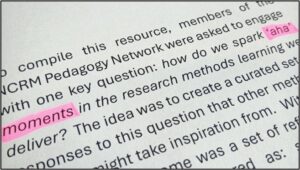
Photo by Alasdair Jones
In the contribution I co-authored with Professor Mel Nind (Jones and Nind 2025), we reflected on what we do in the thematic analysis workshops we run at our respective institutions to help students “get what analysing qualitative data in this thematic way is about, what it looks and feels like, what role the research questions plays, and the importance of the human social researcher in the process” (Jones and Nind 2025: 1). While our specific approaches to that end differed (and hopefully provide alternative approaches that others can adopt), the fundamentals of the teaching approach are the same. That is, we both facilitate hands-on data analysis practice involving instances, analogies and examples to ensure that students move beyond abstract understandings of methodological principles and approaches (Chen and Daehler 2000), and towards skill acquisition fostered through higher forms of cognitive development such as application and analysis (Strayhorn 2016).
As a ‘pedagogical culture’ in research methods teaching in higher education (Wagner, Garner and Kawulich 2011) slowly starts to coalesce (e.g. with the recent launch of the Teaching Educational Research Methods journal) , we can hopefully move from a ‘troubling’ pedagogic situation of trial-and-error methods education (Lewthwaite and Nind 2016: 414) to one where educators can access repositories of resources and have the institutional support to do so, as they would in other more established fields. In turn, students will hopefully benefit from methods teaching delivered by instructors who, like me, treat it as “a passion rather than a chore” (NCRM 2026). Hopefully the ‘sparking aha moments’ resource contributes in a small way to that direction of travel.
References
Centra, J. A. (2009). Differences in responses to the student instructional report: Is it bias? Listening, Learning, Leading, 1-7.
Chen, Z., and Daehler, M. W. (2000) ‘External and internal instantiation of abstract information facilitates transfer in insight problem solving,’ Contemporary Educational Psychology 25(4): 423–449.
Earley, M. (2014) A synthesis of the literature on research methods education, Teaching in Higher Education 19(3): 242–253.
Jones, A. and Nind, M. (2025) Experiencing thematic analysis to answer a specified research question. Available at: https://repository.ncrm.ac.uk/documents/Experiencing_Thematic_Analysis.pdf (Accessed: 29
Lewthwaite, S. and Nind, M. (2016) ‘Teaching Research Methods in the Social Sciences: Expert Perspectives on Pedagogy and Practice’, British Journal of Educational Studies 64(4): 413-430. April 2026).
NCRM (2026) Sparking ‘Aha’ Moments: A Resource for Teaching Research Methods Available at: https://repository.ncrm.ac.uk/resources/trainers/aha.php (Accessed: 29 April 2026).
Strayhorn, T.L. (2016) ‘The (in) effectiveness of various approaches to teaching research methods’, in M. Garner, C. Wagner and B. Kawulich (eds), Teaching Research Methods in the Social Sciences. Routledge, pp. 119-130.
Toogood, C. (2025) ‘Skills and employability: embedding to uncovering’, Higher Education and Policy Institute blog, 23 October. Available at: https://www.hepi.ac.uk/2025/10/23/higher-education-skills-and-employability-looking-beyond-embedding-to-uncovering/ (Accessed: 29 April 2026).
Wagner, C. Garner, M. and Kawulich, B. (2011) ‘The state of the art of teaching research methods in the social sciences: towards a pedagogical culture’, Studies in Higher Education 36(1): 75-88
For more information
This blog post was written by Alasdair Jones