


 View all articles A - Z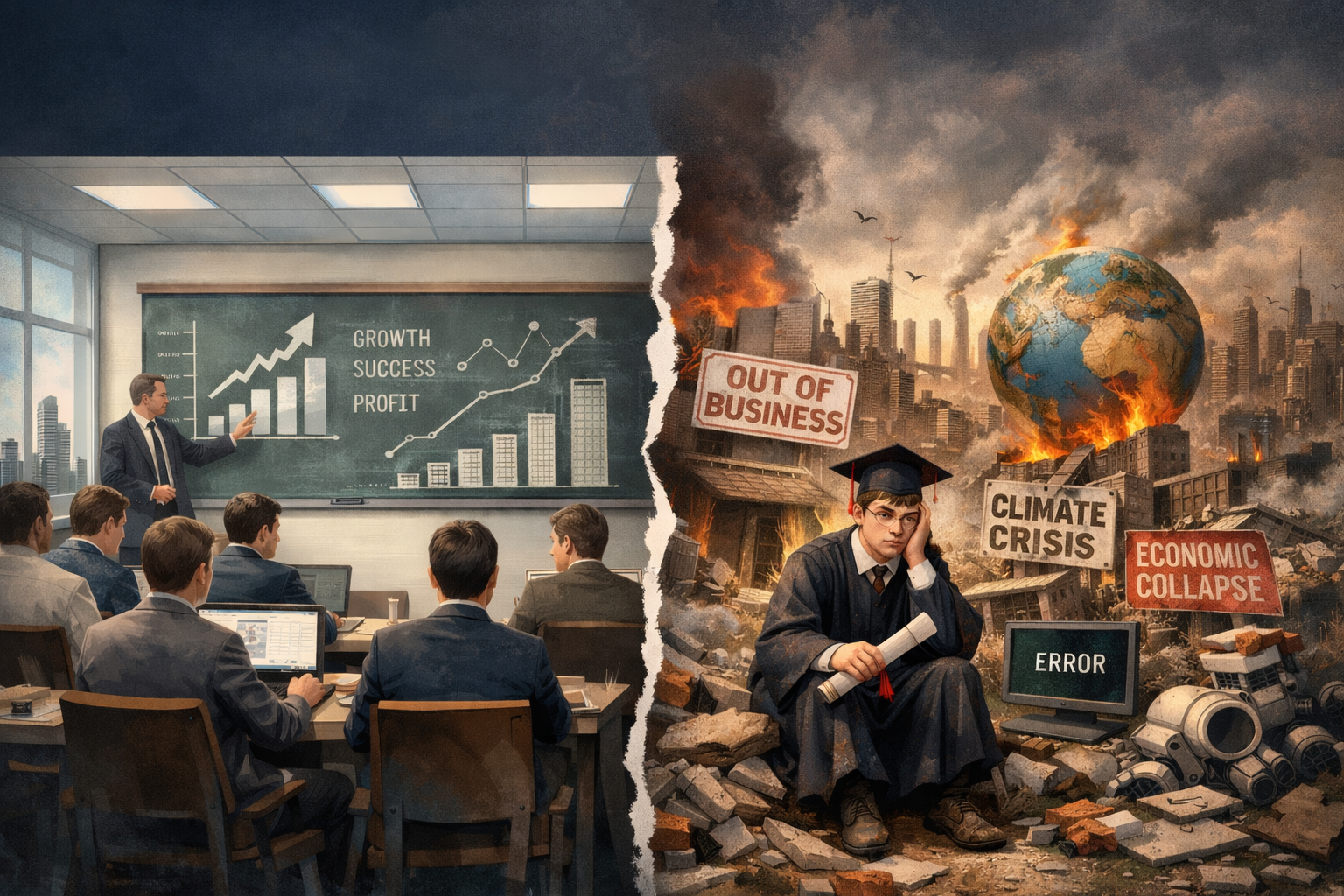
Business Schools are doing a great job of preparing students for a world that no longer exists. Discuss.
12 March 2026
Business Schools are doing a great job of preparing students for a world that no longer exists. Discuss.
In this blogpost we reflect on the current state of education in UK Higher Education Business Schools. We pose a series of radical questions, explain why they matter, and conclude with a challenge.
We argue for a shift in perspective:
- from assuming skills simply emerge, to making them explicit, practiced, and evidenced
- from assessment as measurement to assessment as development; from AI-avoidance to AI-era judgement
- from employability and tutoring as “bolt-ons” to core programme threads.
Interested? Please read on…
What if we could rip up the Business School curriculum and start again?
Business School programme design is rarely a clean-sheet exercise. We inherit structures, patch what isn’t working, respond to new demands, and make sensible compromises within very real constraints. Over time, degrees become carefully engineered… and quietly overcrowded.
But what if we gave ourselves permission to imagine something different? Not because what we have is broken, but because the world they were designed for has changed, at pace. Employers want adaptable graduates. Students want relevance and confidence. Professional bodies want standards. Universities want positive outcomes. And AI is reshaping what “good performance” looks like.
So here’s the thought experiment: what if we really did start again?
Most curriculum change is incremental. We add, but rarely remove. The result? Programmes that prepare students very well for a world that no longer exists.
What if “embedded skills” is a design illusion?
Most Business Schools claim skills are embedded across the curriculum. They usually are. The problem is that “embedded” often means invisible. Students complete group work, presentations, case studies and reflections, yet still struggle to answer a simple question: what skills have you developed, and how do you know?
When skills aren’t explicit, students don’t practice them deliberately, don’t build confidence, and don’t learn how to evidence them. We often assume skills will emerge if students are busy enough. But skills develop through sequencing, feedback, reflection and progression — not exposure alone.
Without clear signposting, students may complete skills-rich tasks without ever recognising what they’ve built.
What if we designed from the graduate backwards, rather than from modules forwards?
Curriculum design often begins with module titles: finance, marketing, strategy, HR, operations, economics. We decide what content to “cover” and then build assessments around those topics.
But what if we started with our graduates? What should they reliably be able to do? How will they articulate and evidence this to employers?
This isn’t just about knowledge or competence — it’s about professional identity. Designing from the graduate backwards means helping students explore pathways, make intentional choices, reflect on progress, and build a clear sense of “this is what I can offer”. Over time, this shifts students from completing tasks to developing capability. They leave not just with a degree, but with confidence, self-awareness and a mindset for lifelong learning.
What if assessment was redesigned first — because it’s the curriculum students actually experience?
Students don’t experience our programme specifications. They experience deadlines and marking criteria. This is why a skills strategy can look excellent on paper but still fail to land. If assessment rewards technical output only, then that’s what students will, understandably, prioritise.
So what behaviours are we actually incentivising?
If we want graduates who can perform professionally, assessment needs to give them repeated opportunities to practice professional performance — with guidance and increasing complexity.
What if we built the degree around authentic business outputs, not academic proxies?
Business Schools are uniquely positioned to design learning around outputs that look and feel like real work, not academic exercises.
What if assessment centred on things like board briefings, client proposals, strategic appraisals, stakeholder communications, dashboards with narrative interpretation, or professional presentations with Q&A?
While these tasks surface skills naturally, incorporating structured reflection into assessment helps ensure students identify, articulate, and evidence their skills growth.
What if we stopped designing around AI avoidance, and started designing around AI-era capability?
Students are already using generative AI. Quietly, inconsistently, and often without confidence. Now that AI can generate plausible content, business education must focus on what AI can’t do alone – judgement, critique, sense-making, and ethical decision-making.
So, what are we actually assessing – the output, or the judgement behind it?
In an AI world, the graduate advantage isn’t answers, it’s discernment. This is where skills become non-negotiable. Students need deliberate practice across the programme, with assessment that rewards critical thinking, justification and responsible decision-making. Our new AI-integrated first year module “Future You” (BEMM1059) is a first step in this direction, with its expansion and further developments later in the student journey planned for next year.
What if academic tutoring was part of programme design, not just pastoral support?
Academic tutoring often sits at the edges of the student experience – valued, but inconsistent and reactive. What if it was designed as a core developmental thread?
Students don’t just need subject knowledge. They need support navigating the transition into university, and from “student” to “emerging professional”. Structured tutoring throughout a programme, involving final year students as role models. can provide a consistent relationship and strengthen belonging. This doesn’t just support wellbeing and retention — it builds reflective, lifelong learners.
In the Business School we are exploring how to link personal tutoring to curriculum, though discussions are still at an early stage. The aim is to foster a sense a belonging and to increase students’ focus on their own personal development.
What if employability wasn’t a bolt-on, but built into the programme design?
Employability often sits alongside the curriculum: a careers talk here, a workshop there, a placement for some, and a final-year scramble for many.
What if employability was a clear programme outcome — developed, practiced and evidenced throughout?
Business Schools are rich with employability expertise: industry-experienced staff, placement students, alumni and employers. But learning only happens if we create structures for that experience to be shared, reflected on and translated. Over time, employability becomes part of the programme’s identity, not an optional extra. Experience alone isn’t learning. Reflection is what turns experience into evidence students can articulate to future employers.
What if we don’t need a perfect redesign — just a braver one?
Programme teams work within real constraints: accreditation, regulation, staffing and time. But constraints don’t have to mean default compromise. We don’t need to rip everything up overnight. But we do need to pause and ask whether our programmes still align with the graduates we want to develop.
If skills, employability, professional identity and AI-era judgement genuinely matter, then programme design needs to reflect that – not just in mapping documents, but in what students actually experience week to week.
So here’s the challenge:
What would you keep because it truly works?
What would you redesign if skills were not the “extra”, but the organising principle of the programme?
And how can we make change happen?
Please note: Article image generated using the following prompt on ChatGPT: Create an appropriate image to publish alongside a blogpost titled: “Business Schools are doing a great job of preparing students for a world that no longer exists.”
For more information please contact:
This post was written by Nicky Thomas and Lisa Harris in the University of Exeter’s Business School.