
Decolonising doctoral supervision: Rethinking power, positionality and partnerships
Decolonisation in higher education has become a popular topic, and it’s not just about tweaking reading lists or including diverse perspectives in curricula.


EduExe blog
Author
Decolonisation in higher education has become a popular topic, and it’s not just about tweaking reading lists or including diverse perspectives in curricula.

Mathematics at the university level is no walk in the park. Many students, including ourselves, have found it challenging not just to grasp complex concepts but also to adapt to a new learning environment.

Since the Covid-19 pandemic we have seen an increase in fully online asynchronous courses, and launch of the University of Exeter Centre for Online.

Philosophy tends to be associated with dense books, abstract theories, and scholars in their armchairs lost in thought.

The University of Exeter Medical School (UEMS) has seen an expansion in student numbers of more than 70% since 2018.

Educators and disability practitioners from across the South-West came together at University of Exeter for a GW4 Alliance funded staff development conference focused on how higher education can implement Universal Design for Learning (UDL) principles in teaching practice.

This case study, co-developed with Tom Wickens, presents an innovative approach to online learning through the use of immersive virtual reality (VR) technology on the Spatial platform.

Success for All is a major strand of our Education Strategy which aims to widen participation, close gaps in student outcomes and build a diverse and inclusive learning environment.

In response to requests from DESE Engage and the SACO forum, we are introducing two new requirements from September 2024 to provide clarity around the use of GenAI in assessments for both staff and students, and to help prevent academic misconduct.

The Educator Development team and School of Education have recently reaccredited our AdvanceHE fellowship framework. As part of the reaccreditation process, we will be relaunching the ASPIRE Framework from September 2024 as the EduExe Framework.

In the 2024/25 academic year, English and Creative Writing will be adopting a new approach to assessing module participation with the aim of increasing the inclusivity of our assessment practices.

What is public speaking anxiety, and how does it affect university students? According to some studies, approximately 10 % of the students at UK universities acknowledge that they struggle with severe social anxiety, and the number of students with a milder form of a fear...

Why playful learning? Industry values graduates with a collaborative mindset who can deliver impactful work.

If we want students to know what is expected of them in an assessment it is critical to have a set of marking criteria that make transparent how they will be assessed.

As educators, we must continue to explore new approaches to assessment that not only assess student learning but also cultivate a deeper understanding of the complex issues at the heart of decolonisation.

Authentic assessment refers to a wide variety of educational and instructional techniques focused on connecting what students are taught to real-world issues, problems, and applications, mirroring the complexities and ambiguities of real life.

Generative AI promises to transform the world of work. Graduates with skills in ethical and proactive use of such tools are in great demand.

Since the launch of open-access Generative AI tools at the end of 2022, educators across the globe have had to stop and question their assessment methods, responding to the potential threat of academic misconduct from these tools.

Students on the second year, 30-credit module ‘Disease, diagnostics and therapeutics’ (CSC2012), engage with a range of formative and summative assessment tasks that help them develop their assessment literacy and evaluative judgement.

Written essays play a significant role in the university assessment ecosystem, but are challenging to mark at scale and when overused don’t generally offer much added value to the student.

A group of Exeter medical students established ‘Melanin Matters’ to expand the dialogue surrounding ethnic diversity in medicine, with a view to facilitate curriculum change which better reflects the global patient population.

Student engagement is a hot topic in education at the moment, and gamification is one way we can create effective and engaging learning environments for our students.

Developing students' professional skills is crucial for their career readiness. But how can educators integrate those practical abilities into academic coursework?

Professor Caroline Keenan, Director of Education and Student Experience and Associate Professor of Law and Legal Education, led an interesting project on helping students become expert learners.

The COVID-19 pandemic has accelerated many changes in higher education, including a greater focus on online learning. However, another key trend has been growing efforts to incorporate the UN's Sustainable Development Goals (SDGs) into university curricula.

Moving to a new country for university can be tough. You're far from home in an unfamiliar environment and you need to figure out your career too!

Online courses have gained a somewhat negative perception over the years. Some believe that they lack the quality and credibility of traditional in-person education.

Reflective writing can be a powerful tool to improve student learning outcomes in university courses. However, many first-year students lack the skills to write reflectively.

Professors Layal Hakim and Peter Ashwin recently ran an insightful session exploring how the two different thinking systems proposed by psychologist Daniel Kahneman affect learning maths.

The pandemic has put student mental health under the spotlight. With all the changes in higher education, how do we make sure wellbeing stays front and centre?

Online assessments provide flexibility but also opportunities for misconduct. Some reports estimate that 1 in 6 students have cheated (Wonkhe, 2022), others suggest the figure is 1 in 14, with 3 in 5 engaging in poor academic conduct (THE, 2022).

Professor Beverley Hawkins, Associate Dean for Education in the University of Exeter Business Schools, shares her top tips for teach large cohorts of students - and keeping them engaged!

In light of recent revelations about the personal life of one of the most infamous quantum physicists, it is time we re-measured Schrödinger’s legacy?

Job hunting can be a stressful activity – just ask any recent graduate. The interview, or several.
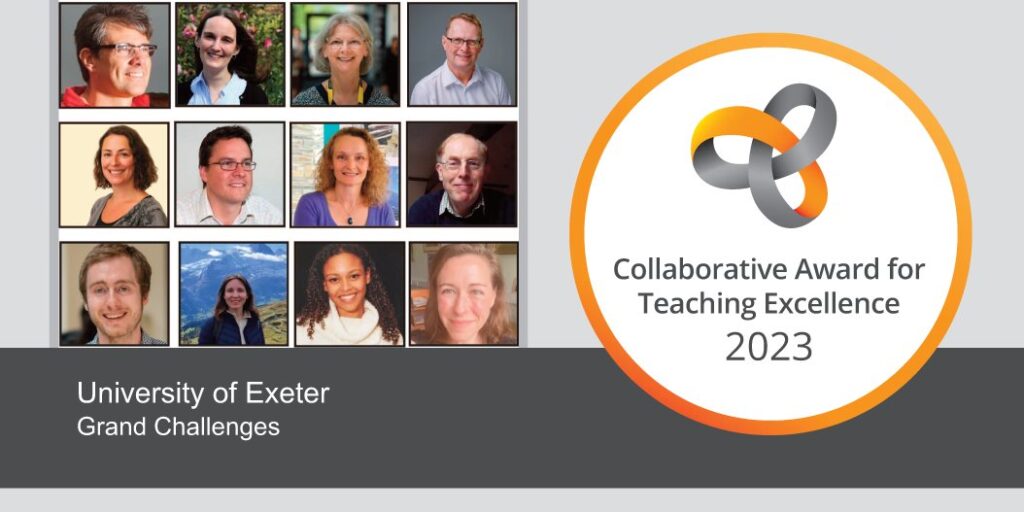
The Grand Challenges team was award a Collaborative Award for Teaching Excellence by AdvanceHE in 2023. The Grand Challenges (GC) team was formed to facilitate inclusive, supportive and creative environments for students to explore ‘wicked’ problems (Rittel and Webber, 1973) and develop their employability.

Colleagues from across the Medical Sciences programme, led by Dr David MacDonald, Dr Dominic Wiredu Boakye, Dr Shalinee Dhayal and Dr Hannah Welters, support students within Academic Tutor Group sessions and activities to develop their academic and professional skills, including their awareness of assessment skills.

In 2022, the Royal Albert Memorial Museum (RAMM) in Exeter presented a collection of 14 alternative blue plaques created by students who were part of the Global Lives: Multicultural Geographies module taught by Professors Nicola Thomas and Ian Cook.

To support central provision provided through LTHE and APP, Classics and Ancient History conducts an annual marking training session for new academic colleagues (including PTAs) and encourages existing teaching staff members to attend.

Dr. Caitlin Kight, Lecturer in Education, has developed a video case study on how the Graduate School of Education helps students engage with feedback.

To improve feedback in Biosciences Streatham, Dr. Alan Brown and Katie Solomon introduced marking and feedback guidelines for 2021/2022.

Dr Layal Hakim, Senior Lecturer and Co-Director of Education and Student Experience in Mathematics and Statistics, shares some effective approaches for supporting students with exams and assessments.

Dr Owen Thomas, Senior Lecturer in Politics and International Relations, has shared his approach to preparing students for assessments on two different modules in Politics.

Assessment in History makes significant use of essays, and module convenors in History are encouraged to dedicate one lecture to essay-writing skills.

Helping students to feel part of a community was been one of the main challenges of the COVID-19 pandemic.
Choose which optional services may run. Necessary cookies used to make the website work are not affected.
Allows analytics tools to measure how the website is used.
Allows content from third-party services such as YouTube to load.